
WhatsApp for UAE Real Estate Brokerages: The Complete 2026 Guide
A practical, real-world guide to how UAE brokerages actually use WhatsApp to convert leads, manage conversations, and scale operations in 2026.
Introduction
In the UAE real estate market, there is a quiet truth that everyone experiences but very few articulate clearly: portals generate attention, but conversations close deals. And those conversations, almost without exception, happen on WhatsApp.
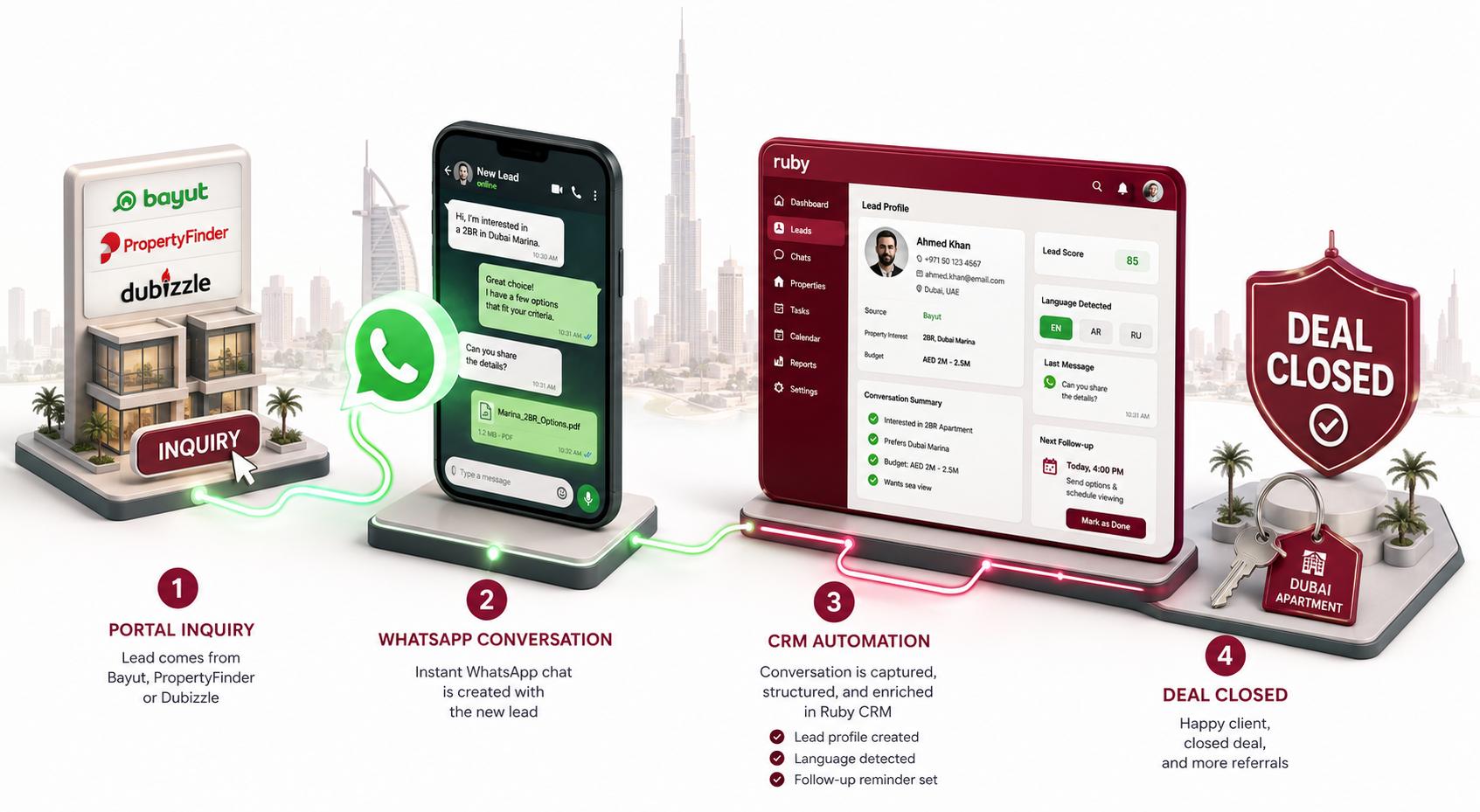
A typical journey is predictable. A buyer browses Bayut or PropertyFinder, sends an inquiry, and within moments expects a response. The platform is only the starting point. From there, the entire decision-making process unfolds inside a chat thread. Questions are asked, images are shared, viewings are scheduled, and trust is built message by message.
Despite this reality, most brokerages still treat WhatsApp as an informal layer rather than a structured system. Agents rely on personal numbers, conversations remain fragmented across devices, and there is little to no visibility into what is actually happening after a lead arrives. The result is not immediate failure, but gradual inefficiency—missed opportunities, delayed responses, and inconsistent follow-ups.
This guide is not about introducing WhatsApp as a tool. It is about understanding how it already functions as the operational backbone of UAE real estate, and how brokerages can evolve from unstructured communication to a system that is scalable, measurable, and reliable.

Why WhatsApp Has Become the Operational Layer
Unlike many global markets where email or CRM systems dominate early interactions, the UAE operates differently. Buyers expect immediacy. They expect conversational engagement. And they expect it on WhatsApp.
This shift has created an environment where the CRM is no longer the first touchpoint. Instead, WhatsApp becomes the primary interface through which relationships are built. The CRM, in many cases, is updated later—if at all.
The problem with this approach is not the use of WhatsApp itself, but the absence of structure around it. When conversations are not captured, tracked, or linked to leads, the brokerage loses visibility into its own pipeline. Managers cannot assess performance accurately, agents cannot maintain consistent follow-ups, and data becomes unreliable.
The most effective brokerages recognize this shift and adapt accordingly. They do not attempt to replace WhatsApp. Instead, they integrate it into a broader system where conversations, leads, and listings are connected.
Where Most Brokerages Struggle
To understand the importance of structure, it helps to look at how most brokerages currently operate.
In one scenario, a shared company number is used by multiple agents. While this may seem efficient initially, it quickly creates confusion. Conversations overlap, ownership becomes unclear, and clients may receive inconsistent responses.
In another scenario, agents rely entirely on personal numbers. While this provides flexibility, it introduces a different set of challenges. Conversations are not recorded centrally, leads cannot be tracked if an agent leaves, and there is no unified view of client interactions.
A third approach involves manually updating a CRM after conversations take place. In practice, this rarely works effectively. Agents are focused on closing deals, not data entry. As a result, information is often incomplete or outdated.
These challenges do not appear dramatic in isolation, but over time they lead to significant inefficiencies. Leads are lost, follow-ups are missed, and opportunities slip through unnoticed.
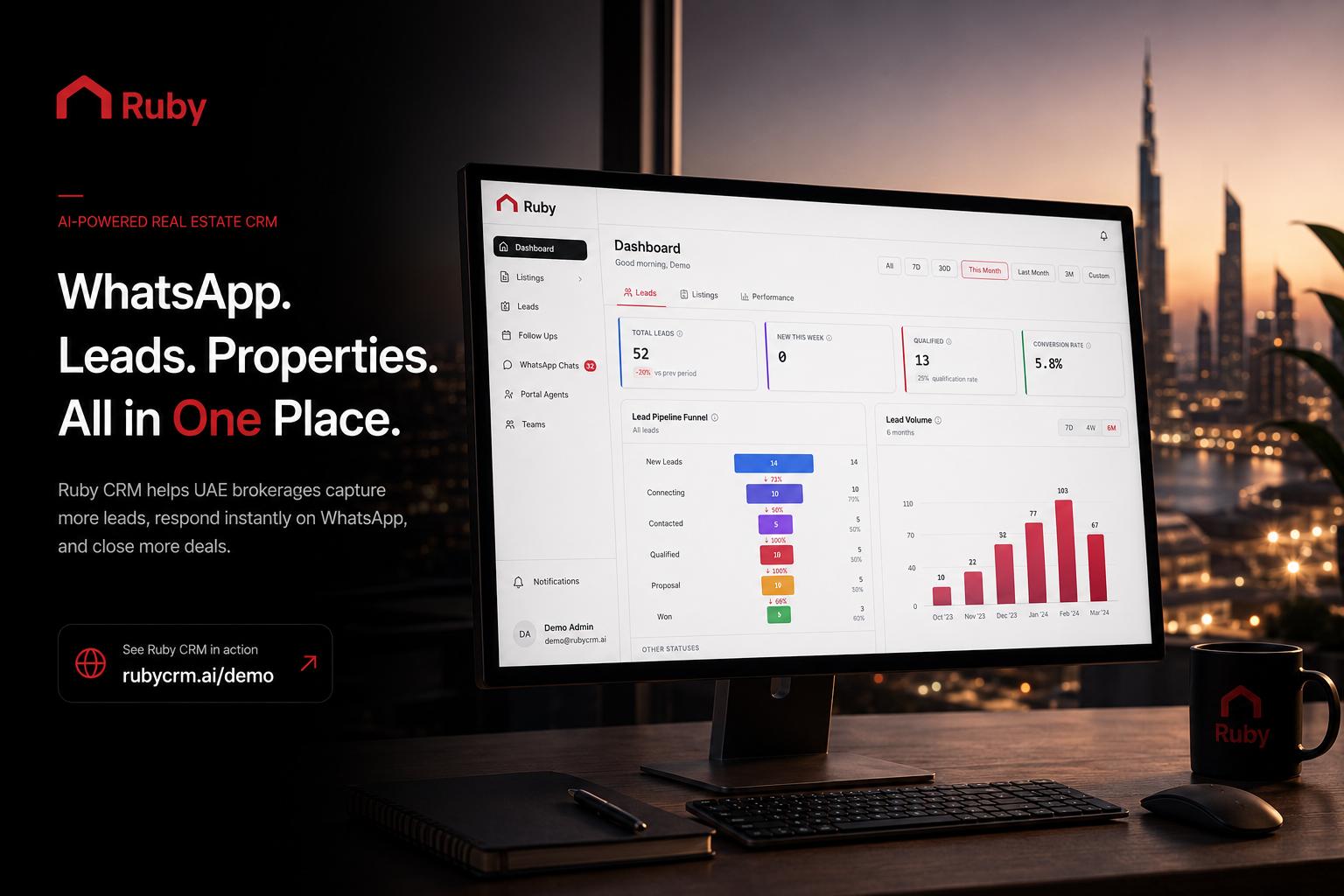
This is exactly where systems like Ruby CRM begin to change how brokerages operate. Instead of conversations living across personal devices, every interaction is captured, linked to a lead, and made visible across the team without forcing agents to change how they communicate.
The Importance of Response Time
One of the most critical factors in WhatsApp-based communication is speed. When a lead sends a message, they are often evaluating multiple options simultaneously. The first meaningful response shapes their perception of professionalism and reliability.
A response within a minute or two creates momentum. A delay of several minutes, especially in a competitive market like Dubai, can shift the conversation entirely to another broker. This is not a reflection of pricing or inventory quality, but simply responsiveness.
For this reason, high-performing brokerages treat response time as a measurable metric rather than an incidental outcome. They design systems that ensure leads are acknowledged immediately, even if a detailed conversation follows later.
In practice, this often means using platforms like Ruby CRM, where leads from portals are captured in real time and an initial WhatsApp response can be triggered instantly, ensuring no inquiry is left waiting.
From Conversations to Structured Data
The real transformation occurs when conversations are no longer isolated events but part of a structured system.
When WhatsApp interactions are connected to lead profiles, several advantages emerge. Agents gain full context before responding, including previous messages, property details, and client preferences. Managers gain visibility into how leads are being handled. And the brokerage as a whole gains access to data that can inform decision-making.
This shift allows conversations to become more than just communication. They become a source of insight. Patterns can be identified, performance can be measured, and strategies can be refined.
Systems like Ruby CRM operationalize this by turning every WhatsApp message, call, and interaction into structured data that can be tracked, analyzed, and acted upon.
Moving Toward Per-Agent Communication Models
A key evolution in modern brokerages is the transition from shared communication channels to per-agent systems. Instead of multiple agents using a single number, each agent operates with their own WhatsApp connection.
This approach introduces clarity. Each lead is associated with a specific agent, ensuring accountability and consistency. At the same time, the brokerage retains oversight, as all conversations are still visible within a centralized system.
The balance between individual ownership and organizational visibility is what enables scalability. Agents maintain personal relationships with clients, while the brokerage ensures continuity and control.
The Role of Automation
Automation, when implemented thoughtfully, enhances rather than replaces human interaction.
For example, an initial response can be sent automatically as soon as a lead is received. This ensures that no inquiry goes unanswered, even during peak hours or outside business times. The message can include relevant details such as the property in question, pricing, or next steps, creating a seamless experience for the client.
Similarly, follow-up reminders can be generated based on conversation activity, ensuring that leads do not go cold due to oversight. These systems do not remove the agent from the process; they support the agent by handling repetitive tasks.
For example, within Ruby CRM, follow-ups can be scheduled automatically based on conversation signals, helping agents maintain consistency without relying on memory alone.
Addressing the Multilingual Nature of the Market
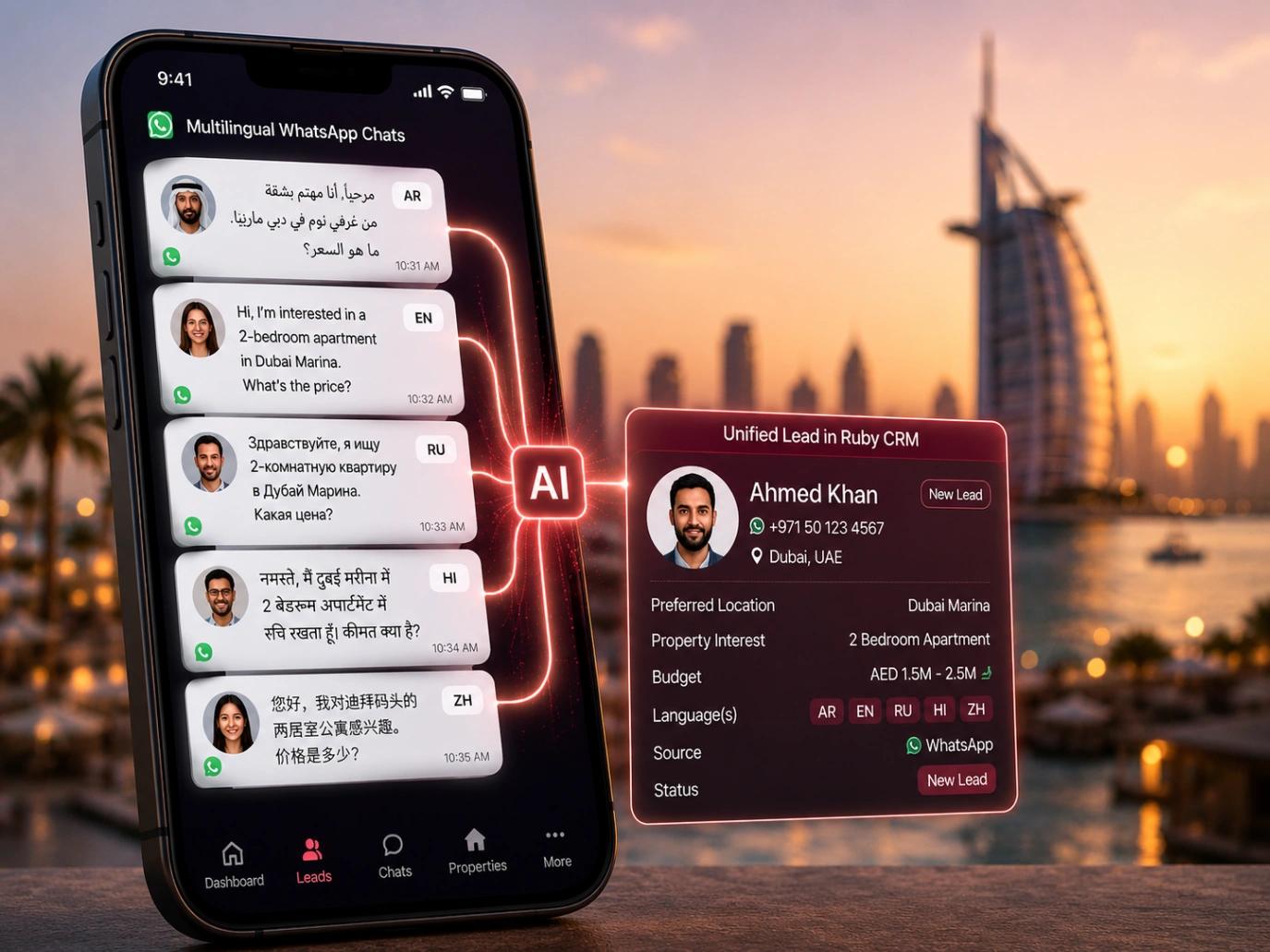
The UAE real estate market is inherently international. Clients come from diverse linguistic backgrounds, and communication barriers can impact the progression of a deal.
Modern systems address this challenge through real-time language detection and translation. Messages can be understood and responded to in different languages without requiring agents to be fluent in each one. This capability reduces friction and enables smoother interactions with a global client base.
The Emergence of Intelligent Systems
Beyond automation, the introduction of AI-driven analysis is redefining how conversations are managed.
By analyzing message content, systems can infer client intent, suggest updates to lead status, and recommend appropriate follow-up actions. This reduces the cognitive load on agents and ensures that important signals are not overlooked.
Instead of relying solely on manual updates, the system itself contributes to maintaining accurate and up-to-date information. This creates a more reliable and responsive workflow.
The Critical Role of Follow-Ups
In many cases, the outcome of a deal is determined not by the initial interaction but by subsequent communication. A well-timed follow-up can revive interest, address concerns, and move the conversation forward.
Without a structured approach, follow-ups are often inconsistent. Agents may forget to reach out, or they may not have visibility into when the last interaction occurred. Over time, this leads to lost opportunities.
A system that tracks and schedules follow-ups ensures continuity. Each lead has a clear next step, and no conversation is left unresolved.
Bringing Everything Together
As brokerages grow, the limitations of unstructured communication become increasingly evident. Managing a high volume of leads, conversations, and listings requires more than individual effort. It requires a system that connects each component.
Platforms designed specifically for real estate operations bring these elements together. They integrate lead capture, WhatsApp communication, listing management, and automation into a single environment. This allows brokerages to operate with clarity, efficiency, and control.
This is where Ruby CRM positions itself differently — not as a generic CRM, but as a system built around how UAE brokerages actually work: WhatsApp-first communication, multi-portal lead capture, and fast-paced deal cycles.
Conclusion
WhatsApp is no longer just a messaging application within the UAE real estate ecosystem. It is the central layer through which relationships are built and transactions are completed.
Brokerages that recognize this and implement structured systems around it are better positioned to respond quickly, manage leads effectively, and maintain consistent communication.
Those that continue to treat it as an informal tool may still generate leads, but they will struggle to convert them at scale.
In a market defined by speed and responsiveness, the difference between success and missed opportunity often comes down to how well a single message is handled.