
How to Set Up a Per-Agent WhatsApp System for Your Brokerage
A practical guide to setting up a per-agent WhatsApp system for real estate brokerages in the UAE, improving lead ownership, response time, and conversion.
Introduction
If you walk into most UAE brokerages and ask how WhatsApp is handled, the answer usually falls into one of two categories.
Either there is a shared company number that multiple agents use, or every agent operates independently using their personal number.
Both approaches work—until they don’t.
At a small scale, these setups feel manageable. Conversations are limited, agents remember their leads, and coordination happens informally. But as lead volume increases, cracks begin to appear. Messages get missed, follow-ups become inconsistent, and no one has a clear view of what is actually happening across the team.
This is where the concept of a per-agent WhatsApp system becomes important. It is not just a technical change. It is a structural shift in how communication, ownership, and accountability are handled within a brokerage.
The Problem With Shared and Personal Setups
To understand why a per-agent system matters, it helps to look at the limitations of existing models.
In a shared-number setup, multiple agents operate from the same WhatsApp account. While this centralizes communication, it creates ambiguity. Conversations overlap, responses are duplicated, and ownership is unclear. Clients may receive inconsistent replies, and follow-ups depend on whoever happens to notice the message.
In a personal-number setup, the opposite happens. Each agent manages their own conversations independently. This creates clear ownership, but removes visibility. Managers cannot track interactions, leads are not centralized, and when an agent leaves, their entire conversation history effectively leaves with them.
Both models solve one problem while creating another. One gives control but lacks accountability. The other gives accountability but lacks control.
What a Per-Agent WhatsApp System Actually Means
A per-agent WhatsApp system is designed to combine the strengths of both models without inheriting their weaknesses.
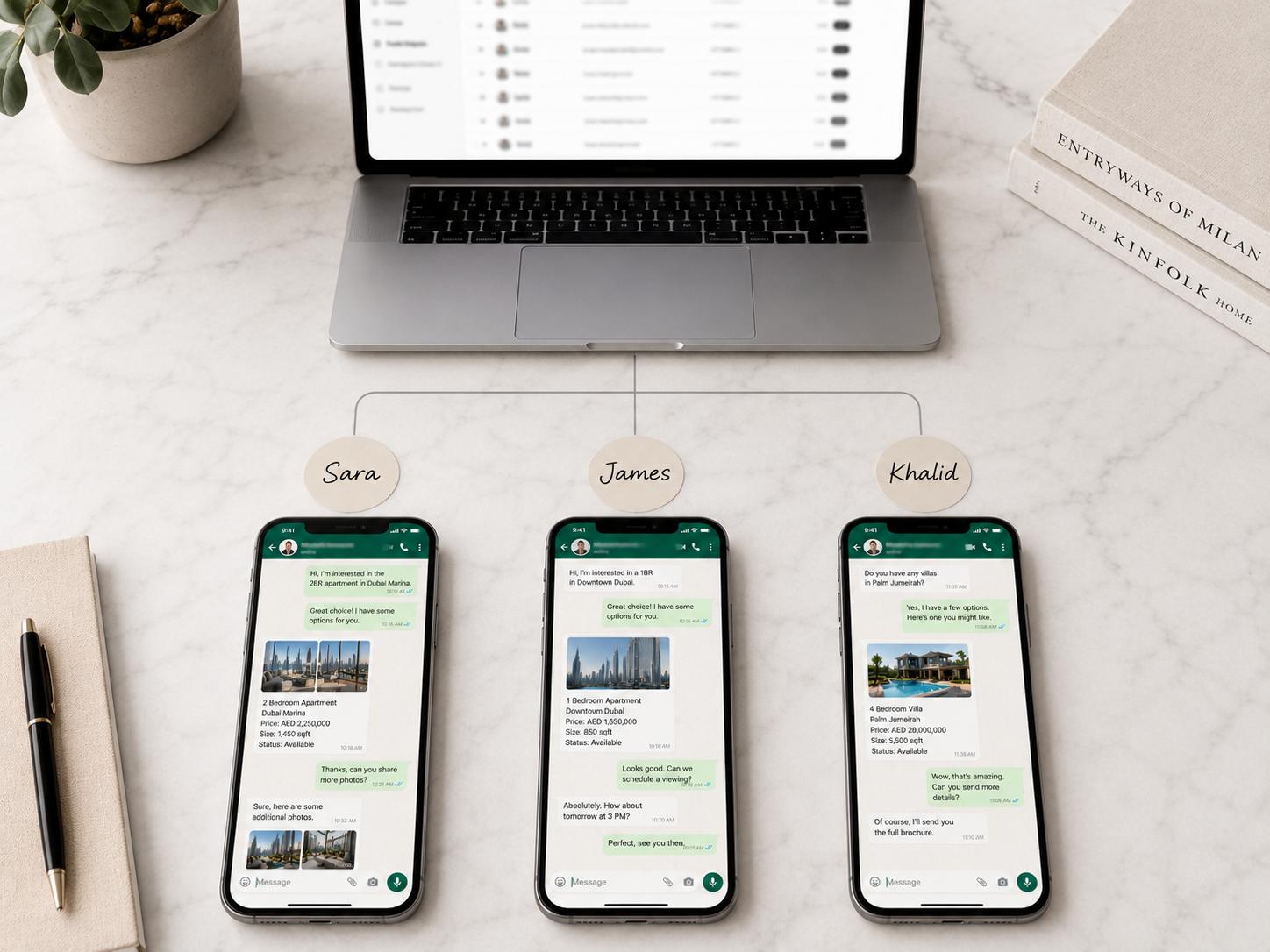
Each agent operates with their own WhatsApp connection, maintaining direct communication with their clients. At the same time, those conversations are connected to a centralized system where leads, messages, and activities are tracked.
This creates a structure where:
-
Every lead has a clear owner
-
Every conversation is visible at the company level
-
No data is lost if an agent leaves
-
Managers can monitor performance without interfering in conversations
The goal is not to change how agents communicate, but to ensure that communication is captured and structured.
Step 1: Connecting WhatsApp at the Agent Level
The first step is enabling each agent to operate with their own WhatsApp Business connection.
Instead of routing all conversations through a single number, each agent connects their individual WhatsApp account to the system. This ensures that when a lead is assigned, the conversation naturally flows to the right person.
In platforms like Ruby CRM, this is done through direct integration with the WhatsApp Business API, allowing each agent to connect their number securely while keeping conversations synchronized inside the CRM.
This approach preserves the personal nature of communication while bringing it into a structured environment.
Step 2: Linking Conversations to Leads
Once WhatsApp is connected at the agent level, the next step is ensuring that every conversation is tied to a lead profile.
When a message is received, it should not exist as an isolated chat. It should be linked to a specific lead, along with relevant details such as property interest, source, and previous interactions.
This allows agents to respond with full context, rather than treating each message as a new conversation. It also ensures that the brokerage has a complete record of interactions.
Ruby CRM handles this by automatically matching WhatsApp messages to leads using phone numbers and linking them to the corresponding profiles.
Step 3: Defining Clear Ownership Rules
A per-agent system only works if ownership is clearly defined.
When a lead arrives, there must be a rule that determines who it belongs to. In most cases, this is the listing agent. If that is not available, fallback rules can assign the lead based on portal data or predefined logic.
The key is that every lead should be assigned immediately and visibly. There should be no ambiguity about who is responsible for responding and following up.
Within Ruby CRM, this is handled through automated lead assignment, ensuring that leads are routed to the right agent within seconds of arriving.
Step 4: Maintaining Visibility Without Interference
One of the biggest concerns brokerages have is balancing control with autonomy.
Agents need the freedom to communicate naturally with clients. At the same time, managers need visibility into what is happening.
A well-designed per-agent system solves this by separating communication from oversight. Agents handle conversations directly, while the system logs messages, tracks activity, and provides visibility to managers.
This means managers can review performance, identify bottlenecks, and support agents without stepping into every conversation.
Step 5: Structuring Follow-Ups at the Agent Level
Even with clear ownership, follow-ups remain a critical challenge.
In a per-agent system, follow-ups should be tied directly to the agent responsible for the lead. Each interaction should result in a next step, whether it is a call, message, or meeting.
Instead of relying on memory, the system should prompt agents when follow-ups are due and track whether they are completed.
Ruby CRM supports this by allowing follow-ups to be scheduled, automated, and monitored, ensuring that no lead is left unattended after the initial conversation.
Step 6: Handling Mobility and Real-World Usage
Real estate agents are rarely at their desks. They are on calls, at viewings, or moving between locations.
A per-agent system needs to support this reality. Agents should be able to reply from their phones while still having those conversations reflected in the central system.
Modern setups allow for this through synchronization, where messages sent from the agent’s device are mirrored in the CRM. This ensures continuity without forcing agents to change their workflow.
Why This Model Scales Better
The real advantage of a per-agent WhatsApp system becomes clear as the brokerage grows.
With increasing lead volume, the need for structure becomes more critical. A system that clearly defines ownership, captures conversations, and ensures consistent follow-ups can handle scale without breaking down.
Without this structure, growth often leads to chaos. More leads result in more missed opportunities, not more deals.
Conclusion
Setting up a per-agent WhatsApp system is not just a technical upgrade. It is a shift toward structured communication.
By combining individual ownership with centralized visibility, brokerages can improve response time, maintain consistent follow-ups, and retain control over their data.
In a market where conversations drive conversions, the way those conversations are managed becomes a key differentiator.
Brokerages that adopt a structured, per-agent approach are better equipped to scale, perform consistently, and turn inquiries into closed deals.