
AI vs traditional CRM: what's changing for Dubai real estate agencies?
Discover how AI-powered CRMs are transforming Dubai real estate agencies with intelligent automation, multilingual communication, smart follow-ups, and higher lead conversion.
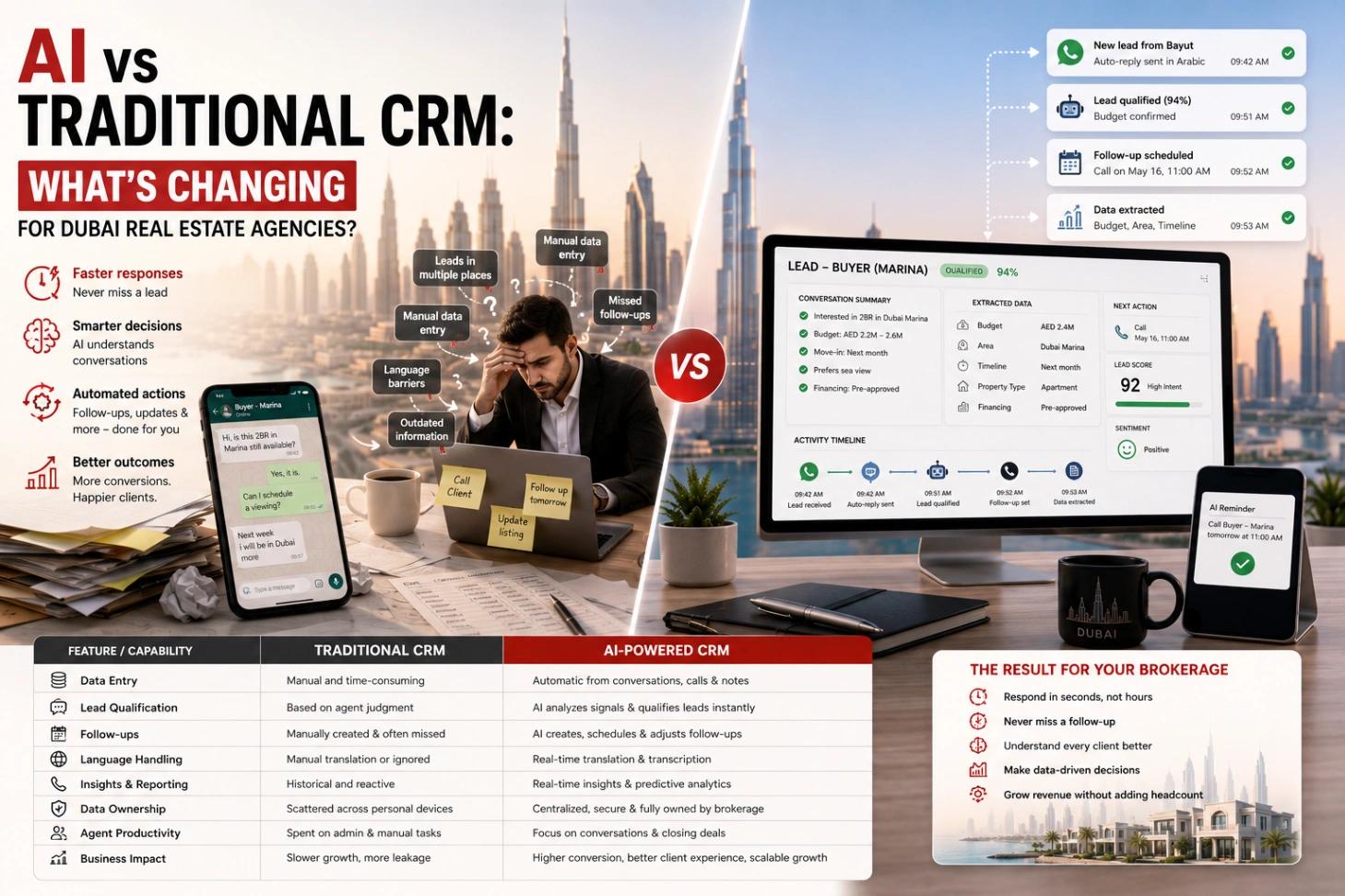
For most of the last decade, a real estate CRM in Dubai did roughly the same job as a CRM anywhere else: store contact details, log a call, remind someone to follow up, show a pipeline view. The system held whatever an agent typed into it. If an agent didn't type it in, the system simply didn't know it. That was the deal, and brokerages built their whole operation around it.
That deal is changing, and it's worth being specific about what's actually different, since "AI-powered CRM" has become a phrase attached to almost anything with a chatbot bolted on. The real shift is software that reads a conversation, decides something about it, and acts, instead of waiting for a person to notice, interpret it, and type it in. Everything below is an attempt to pin down that difference precisely, because a brokerage choosing between platforms in 2026 needs a sharper test than the word "AI" on a pricing page.
What a traditional CRM was actually built to do
A traditional CRM is, at its core, a filing cabinet with a search function. It records what an agent tells it: a lead's name, a status the agent selected from a dropdown, a note the agent typed after a call. It's accurate exactly to the extent that agents keep it accurate, which in a fast-moving brokerage is inconsistently, at best.
That model worked reasonably well when most client contact happened by phone or email. Both channels are naturally logged, and both move slowly enough for an agent to update a record afterward. It starts to strain the moment most of the relationship moves into a channel that never pauses for data entry, which is exactly what happened in Dubai.
Where the traditional model started to break in this market
Dubai's market pushes harder on a CRM than most. Listings live across several portals at once: Bayut, PropertyFinder, Dubizzle, Skyloov, each with its own dashboard, its own lead stream, and its own wallet of paid credits. WhatsApp carries the bulk of client communication rather than email. Buyers arrive speaking Russian, Mandarin, Hindi, French, Arabic, and a dozen other languages, often from time zones where their 2 p.m. is the office's midnight. And the pace of enquiries doesn't leave much room for an agent to sit down and update records between conversations.
A traditional CRM has no answer to any of that on its own. Someone still has to notice that a WhatsApp thread implies the client is now qualified, remember to change the status manually, and log what was discussed before it's forgotten. There's also a whole layer of client communication a typed record never captures at all: the voice note where a landlord agreed to a price, the portal call where a buyer mentioned their mortgage pre-approval. Multiply that across dozens of agents and hundreds of live conversations, and the record in the CRM lags further and further behind what's actually happening with each client. Managers end up running the business on a snapshot that's three days stale.
What's actually different with AI in the loop
What changed is narrower than "software now has opinions." Specific, well-defined judgment calls that used to require an agent to stop and update a record can now happen automatically, based on the conversation itself.
Take lead status. In a traditional setup, an agent decides when a lead has moved from "new" to "qualified," and updates a dropdown to reflect it, assuming they remember to. In Ruby CRM, when a customer sends a WhatsApp message, the conversation is analyzed against the lead's history, and the system proposes a status change along with a confidence score and a plain-language reason. If that confidence clears a set threshold, the status updates on its own. If it doesn't, the suggestion is logged for a human to look at rather than applied blindly. The record stays current without anyone having to remember to touch it.
Follow-up scheduling works the same way. Instead of an agent deciding, after a call ends, to set a reminder for three days out, the system reads the conversation and decides whether a follow-up should be created, rescheduled, or cancelled, based on what was actually said. A client who mentions they're travelling for two weeks gets a follow-up pushed out accordingly, without an agent having to catch that detail and act on it manually.
Interest data follows the same pattern. A budget mentioned in passing, a preferred area named halfway through a WhatsApp thread, a move-in timeline dropped into a voice note: all of it used to depend on an agent typing it into a notes field later, if they remembered at all. Now it's extracted directly from the conversation and stored as structured data the moment the system is confident enough to use it.
Language is the piece that matters most in this market specifically. An Arabic enquiry gets translated live, both directions, so the agent replies in English and the client reads it in Arabic. Voice notes get transcribed and summarized instead of sitting as unplayed audio. Call recordings from Bayut and PropertyFinder get the same treatment, with the conversation summarized and the client's sentiment and intent tagged on the lead. None of that was ever going to be typed into a notes field by a busy agent. It only exists as data because software read the conversation itself.
A single lead, end to end
The difference is easiest to see on one concrete lead. An enquiry lands from Bayut at 9:42 in the morning: a buyer asking, in Arabic, whether a two-bedroom in Marina is still available. The message is translated on arrival. A WhatsApp reply goes out in Arabic, personalized with the property and price. Nine minutes later, after the buyer confirms budget and asks for a viewing, the status moves to qualified on its own, at 94% confidence, with the reason logged. A follow-up call gets scheduled and synced to the agent's Google Calendar. A bilingual brochure is generated and shared in the same thread.
In a traditional CRM, that same morning looks like this: the enquiry sits in the Bayut dashboard until someone checks it, the Arabic message waits for whoever in the office reads Arabic, and the status changes whenever the agent next opens the CRM, if they do. Same lead, same agent, same market. The difference is how much of the work happened while nobody was looking.
Automation is not the same as intelligence
It's worth separating two things that get lumped together under "AI-powered." Syncing a listing to four portals automatically, or pulling a lead in from a Meta lead-ad webhook the instant the form is submitted, is automation. It's useful, but it isn't a judgment call. It's the same result every time, given the same input.
What's newer is software making an actual judgment: deciding that a conversation implies a status change, deciding that a follow-up should move, deciding what a client's real budget probably is from a scattered conversation. That's a different category of feature, and it's the one actually changing what a CRM is for.
| Traditional CRM | AI-driven CRM | |
|---|---|---|
| Lead status | Agent updates a dropdown manually | Updated from the conversation, with confidence score and logged reason |
| Follow-ups | Agent sets reminders by hand | Scheduled, moved, or cancelled based on what was said |
| Client preferences | Typed into a notes field, sometimes | Budget, areas, and timeline extracted from chat automatically |
| Voice notes and calls | Unlogged audio | Transcribed, summarized, sentiment and intent tagged |
| Languages | Agent's problem | Translated live, both directions, 150+ languages |
| Record accuracy | As good as agent discipline | As good as the conversation itself |
A brokerage evaluating a platform should ask which of these two categories a given feature falls into. A vendor calling a webhook sync "AI-powered" isn't describing the same capability as a system that reads a conversation and updates a record based on what it means.
The trust question, and why the audit trail matters more than the AI
Any brokerage owner should be skeptical of software making decisions on its own, and that skepticism is healthy. The answer is to make every decision visible and reversible, so trust never has to be blind. Every status change Ruby's AI makes is logged with the reasoning behind it and the confidence score attached, whether or not the change was applied. A daily digest lands at 9 p.m. summarizing what the AI did across an agent's leads that day, so nothing happens in the background unnoticed. An agent can always override a decision, and that override itself is tracked, which over time shows where the AI's judgment tends to be right and where it needs adjusting. Company admins can also switch AI analysis off entirely, or raise how confident it needs to be before acting on its own.
That combination, visible reasoning plus a human able to override plus a full record of what happened, is what makes automated judgment calls usable in a business where a wrong status change or a missed follow-up has a real cost. Without the audit trail, "AI-powered" is a black box making decisions nobody can check.
What doesn't change
None of this replaces an agent. AI can flag that a lead sounds ready to view a property, but it doesn't do the viewing, negotiate the price, or build the trust that actually closes a deal in this market. What it changes is how much of an agent's day goes toward keeping records current instead of talking to clients. A system that updates itself based on what's already being said removes a layer of admin work that never helped anyone close anything. It was just overhead that came with running a CRM the old way.
How to actually choose between the two
"Does this CRM have AI" is the wrong question, because every vendor now answers yes regardless of what's happening under the surface. The better question is which specific decisions the system can make on its own, from a real conversation, and whether every one of those decisions is logged clearly enough that a manager could check it and disagree. A CRM that still requires an agent to manually update a status after every WhatsApp message is a traditional CRM with a chatbot attached. A CRM that reads that same message and updates the record itself, with a clear reason attached, is doing something genuinely different, and in a market moving as fast as Dubai's, that difference shows up in conversion, not just in a shorter to-do list.
Frequently asked questions
What's the difference between an AI CRM and CRM automation?
Automation produces the same output for the same input: a listing syncs to a portal, a webhook creates a lead. An AI CRM makes judgment calls from unstructured input, like reading a WhatsApp thread and deciding the lead is now qualified. Most platforms have the first; far fewer genuinely have the second.
Is an AI CRM worth it for a small Dubai brokerage?
Smaller teams often benefit more, because there's no admin staff to compensate for missed data entry. A five-agent office where the CRM updates its own statuses and schedules its own follow-ups behaves, operationally, like an office with a full-time coordinator it isn't paying for.
What happens when the AI gets a status change wrong?
In a properly built system, the change was applied only above a confidence threshold, the reasoning was logged, and the agent can reverse it in one click. That override is recorded too, so repeated mistakes surface as a pattern the admin can act on, either by raising the threshold or turning auto-actions off for that stage.
Do agents still need to update the CRM at all?
Less, but not never. Anything that happens inside a tracked channel, like WhatsApp or portal calls, is captured and interpreted automatically. Anything that happens outside it, like a handshake conversation at a viewing, still needs a human to record it, and probably always will.
If you want to see the difference on your own pipeline rather than a demo dataset, book a Ruby CRM walkthrough. It runs on your actual leads, takes about 30 minutes, and if it doesn't fit the way your brokerage works, we'll say so.
Ready to Transform Your Real Estate Business?
Join hundreds of brokers using Ruby CRM to automate lead management and close more deals.