
Live WhatsApp Translation in 150+ Languages: How Dubai Brokers Close International Buyers
Learn how live WhatsApp translation helps Dubai real estate brokers communicate with global buyers, remove language barriers, and improve conversion rates.
Introduction
Dubai’s real estate market does not operate in a single language. It operates across dozens of them.
On any given day, a broker might receive inquiries from a Russian investor, a Chinese buyer, a French expatriate, or an Arabic-speaking family. Each conversation begins the same way—a message on WhatsApp—but quickly diverges based on one critical factor: language.
For many brokerages, this is where friction begins. Not because agents lack skill or intent, but because communication itself becomes a barrier.
And in a market where speed and clarity define conversion, even small misunderstandings can cost deals.
The Hidden Cost of Language Friction
Language gaps rarely appear as obvious failures. A buyer does not say, “I didn’t proceed because of translation issues.” Instead, the conversation becomes slower, less precise, and less confident.
A client asks a detailed question in their native language. The agent translates it manually, often losing nuance. The reply comes back in English, which the client partially understands. The exchange continues, but each step introduces friction.
Over time, this friction accumulates. The buyer feels less confident. The agent feels less certain. The conversation loses momentum.
In many cases, the deal is not lost because of pricing or availability, but because communication never reached the level of clarity required to build trust.
Why Multilingual Teams Are Not Enough
One common solution is to hire agents who speak multiple languages. While this helps, it does not fully solve the problem.
Brokerages cannot realistically cover every language with dedicated agents. Even when they do, matching leads to the right language-speaking agent introduces delays. A lead may sit unassigned while the team determines who can handle it.
This creates a trade-off between speed and specialization.
In a fast-moving market like Dubai, that trade-off is costly.
The Shift Toward Real-Time Translation
Modern brokerages are moving toward a different approach: enabling every agent to communicate across languages without needing to be fluent.
Real-time translation allows messages to be understood and responded to instantly, regardless of the language used by the client.
Instead of translating manually or reassigning leads, the system detects the language, translates incoming messages, and allows the agent to reply in their own language while the client receives it in theirs.
This removes the delay and preserves the flow of conversation.
How Translation Changes the Conversation Dynamic
When language is no longer a barrier, the conversation becomes more natural.
The client expresses intent clearly in their native language. The agent understands the context immediately. Responses are delivered quickly and accurately.
This has a direct impact on trust. The client feels understood, not managed. The agent feels confident, not reactive.
In a market where many buyers are international investors, this clarity can be the difference between a casual inquiry and a serious discussion.
Integrating Translation Into WhatsApp Workflows
For translation to be effective, it cannot exist as a separate tool. It needs to be embedded within the communication workflow.
Agents should not have to copy messages into external translators, switch between apps, or manually reconstruct responses. Each of these steps introduces delay and increases the chance of error.
Instead, translation should happen directly within the WhatsApp conversation interface.
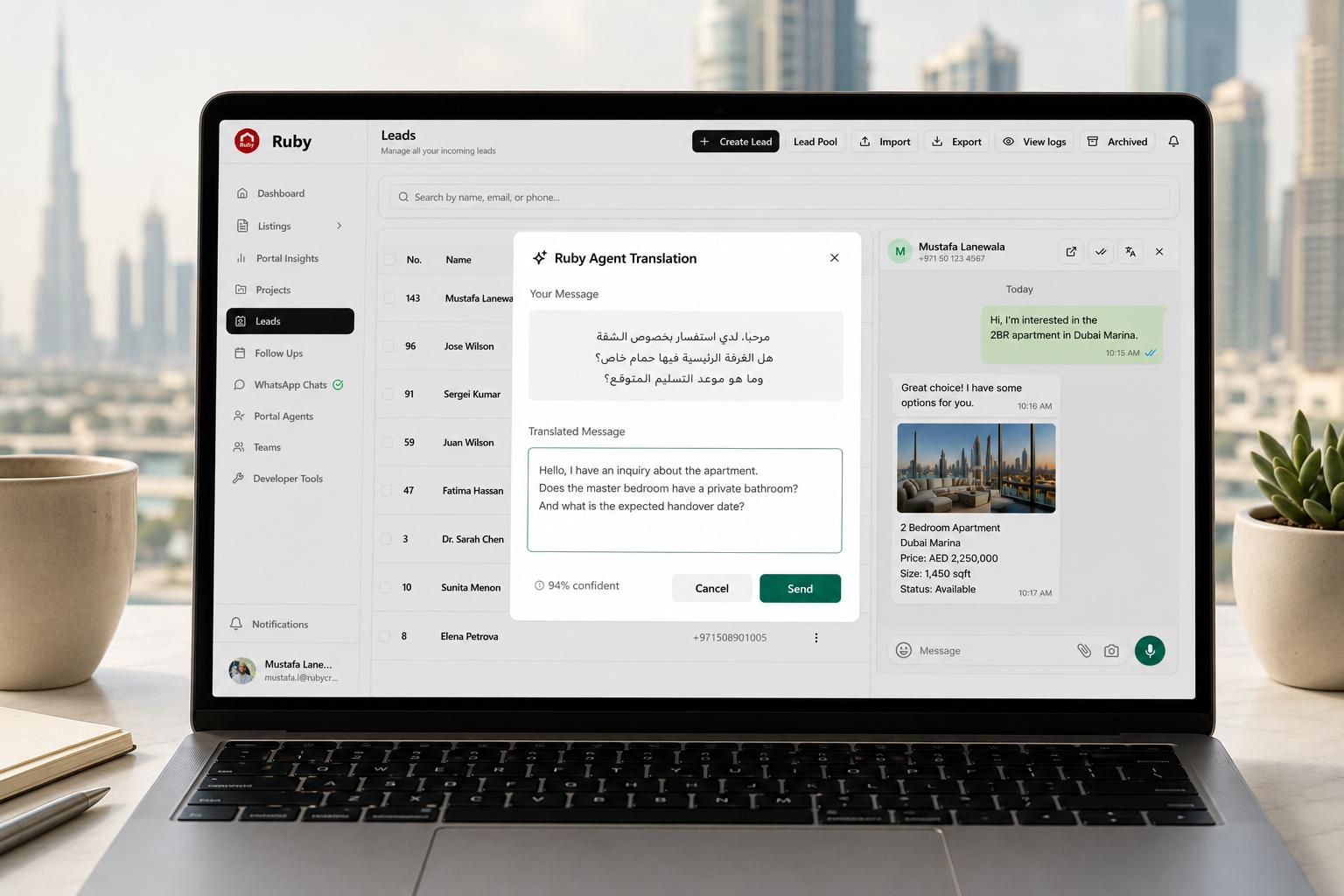
Platforms like Ruby CRM enable this by detecting the language of incoming messages automatically and providing translated versions within the same conversation view. Agents can reply in their preferred language, while the system handles translation on the outbound message.
Maintaining Accuracy and Context
One concern with translation systems is accuracy. Real estate conversations often include specific terms, pricing details, and location references that need to be conveyed precisely.
Modern translation systems address this by using context-aware models that consider the full conversation rather than translating messages in isolation. This improves accuracy and reduces the risk of miscommunication.
Additionally, agents can review and adjust translated messages before sending, ensuring that the final communication aligns with their intent.
Speed as a Competitive Advantage
In multilingual environments, speed often determines which broker controls the conversation.
If one broker takes several minutes to understand and respond to a message while another replies instantly with clarity, the outcome is predictable.
Real-time translation allows brokerages to compete on speed without sacrificing accuracy. Every agent can respond immediately, regardless of language, maintaining momentum from the first message.
Beyond Translation: Understanding Intent
Translation is only the first layer. The next step is understanding what the client actually wants.
When combined with intelligent systems, translated conversations can be analyzed to extract intent, preferences, and urgency. This allows agents to respond more strategically rather than simply reacting to messages.
Within Ruby CRM, translated WhatsApp conversations can feed into AI-driven analysis that identifies buyer intent, updates lead status, and suggests follow-ups, creating a more informed and responsive workflow.
Why This Matters More in Dubai Than Anywhere Else
Few markets are as internationally diverse as Dubai. Buyers come from different cultural and linguistic backgrounds, each bringing their own expectations and communication styles.
In such an environment, the ability to communicate seamlessly across languages is not just an advantage. It is a requirement.
Brokerages that rely solely on English or limited language coverage may still operate, but they will struggle to fully engage with a global client base.
Those that remove language barriers entirely position themselves to capture a much broader range of opportunities.
Conclusion
Language has always been a barrier in global markets. In Dubai’s real estate sector, it is one of the few remaining points of friction in an otherwise highly digital and fast-moving environment.
By integrating real-time translation directly into WhatsApp workflows, brokerages can eliminate that friction. Conversations become faster, clearer, and more effective.
For agents, this means confidence in every interaction. For clients, it means feeling understood from the first message.
And in a market where communication drives conversion, that difference is significant.