
AI for Real Estate Brokerages: The Complete 2026 Guide
Discover how AI is transforming UAE real estate brokerages through lead qualification, WhatsApp automation, conversation intelligence, follow-up management, and operational efficiency.
Introduction
For years, real estate technology has focused on a relatively simple goal: helping brokerages manage information.
CRMs stored leads. Portals generated inquiries. Listing systems organized inventory. Reporting tools measured performance.
The technology improved, but the fundamental workflow remained largely unchanged. Humans still carried the operational burden. Agents manually updated lead statuses, remembered follow-ups, qualified prospects, responded to messages, and pieced together information scattered across multiple platforms.
As brokerages grew, so did the complexity.
More leads meant more conversations. More conversations meant more administrative work. More administrative work meant less time spent on activities that actually generate revenue.
This is the environment that artificial intelligence is beginning to reshape.
AI is no longer a futuristic concept reserved for large enterprises. It has become a practical operational layer that sits alongside agents, helping brokerages manage communication, automate repetitive work, identify opportunities, and maintain consistency at scale.
The most successful brokerages in 2026 will not necessarily be the ones with the largest teams or the biggest marketing budgets. They will be the ones that learn how to combine human expertise with intelligent systems.
The Real Estate Industry's Efficiency Problem
The modern brokerage faces a unique challenge.
Lead generation has become easier than ever before.
A brokerage can receive inquiries from portals, websites, social media campaigns, referral programs, and messaging platforms simultaneously.
While this sounds like a positive development, it often creates a new problem: operational overload.
Every lead requires attention.
Every inquiry requires a response.
Every conversation requires follow-up.
Every opportunity requires tracking.
As volume increases, consistency becomes increasingly difficult to maintain.
The challenge is not a lack of effort. Most agents work extremely hard. The challenge is that humans are being asked to manage hundreds of small decisions and repetitive tasks every week.
This creates bottlenecks that directly impact conversion rates.
Why AI Is Different From Traditional Automation
Automation has existed in real estate software for years.
Rules-based workflows can send emails, create tasks, and move leads through predefined stages.
AI operates differently.
Traditional automation follows instructions.
AI understands context.
For example, a conventional automation rule may send a follow-up after three days.
An AI system can analyze the conversation itself, determine whether the client remains interested, identify buying signals, and recommend an appropriate next action.
The difference is significant.
Instead of simply executing instructions, AI helps brokerages make better decisions.
The Rise of Conversation Intelligence
The majority of modern real estate conversations happen inside messaging platforms.
WhatsApp, in particular, has become the primary communication channel across the UAE property market.
Every day, agents exchange thousands of messages with buyers, sellers, tenants, landlords, and investors.
Historically, these conversations existed in isolation.
Important information remained buried inside chat threads.
Lead intent was difficult to assess.
Managers lacked visibility.
Follow-ups depended entirely on memory.
AI changes this dynamic by transforming conversations into structured information.
Instead of viewing messages as isolated communication, intelligent systems analyze them for patterns, intent, urgency, sentiment, and opportunity.
This creates a completely different level of operational awareness.
AI-Powered Lead Qualification
One of the most valuable applications of AI in real estate is lead qualification.
Traditionally, agents evaluate leads manually.
They determine whether a prospect is serious, identify their budget, understand their timeline, and assess their likelihood of converting.
This process consumes significant time and often relies on subjective judgment.
AI can assist by analyzing conversations and identifying signals that indicate buying intent.
For example, a prospect asking detailed questions about financing, payment plans, or viewing availability typically demonstrates stronger intent than someone requesting basic information.
By analyzing these patterns consistently across thousands of interactions, AI can help brokerages prioritize the opportunities most likely to convert.
This allows agents to focus their energy where it creates the greatest impact.
The Challenge of Follow-Ups
Most real estate deals are not closed during the first conversation.
In many cases, the decision-making process unfolds over days, weeks, or even months.
This makes follow-up management one of the most important aspects of brokerage operations.
Unfortunately, it is also one of the most inconsistent.
Agents become busy.
New leads arrive.
Older conversations become buried.
Important opportunities gradually lose momentum.
AI helps solve this problem by creating a structured follow-up system.
Instead of relying entirely on memory, intelligent systems can identify when a conversation requires attention, recommend the next step, and ensure that opportunities remain active.
The objective is not to replace the agent.
The objective is to ensure that valuable opportunities do not disappear because of operational oversight.
From Data Entry to Data Intelligence
One of the most frustrating aspects of traditional CRM usage is manual data entry.
Agents close conversations.
Managers request updates.
Lead statuses change.
Yet keeping systems current requires ongoing administrative effort.
As a result, CRM data often becomes outdated.
Artificial intelligence introduces a different approach.
Instead of expecting agents to update every detail manually, AI can analyze conversations and suggest status updates automatically.
A discussion about scheduling a viewing may indicate a progression in the sales journey.
A conversation about financing may suggest stronger purchase intent.
Repeated inactivity may signal a cooling lead.
By extracting insights directly from communication, AI helps maintain more accurate records while reducing administrative workload.
Multilingual Communication at Scale
The UAE property market attracts buyers from around the world.
Every brokerage interacts with clients who speak different languages, have different expectations, and communicate differently.
Historically, language barriers created friction.
Conversations became slower.
Nuances were lost.
Trust took longer to establish.
Modern AI systems can bridge these gaps through real-time language detection and translation.
Agents can communicate naturally while the technology handles translation behind the scenes.
This allows brokerages to serve a global audience without requiring dedicated language specialists for every market segment.
How Ruby CRM Applies AI to Brokerage Operations
The most valuable AI implementations are not standalone tools.
They are integrated directly into everyday workflows.
This is the philosophy behind Ruby CRM.
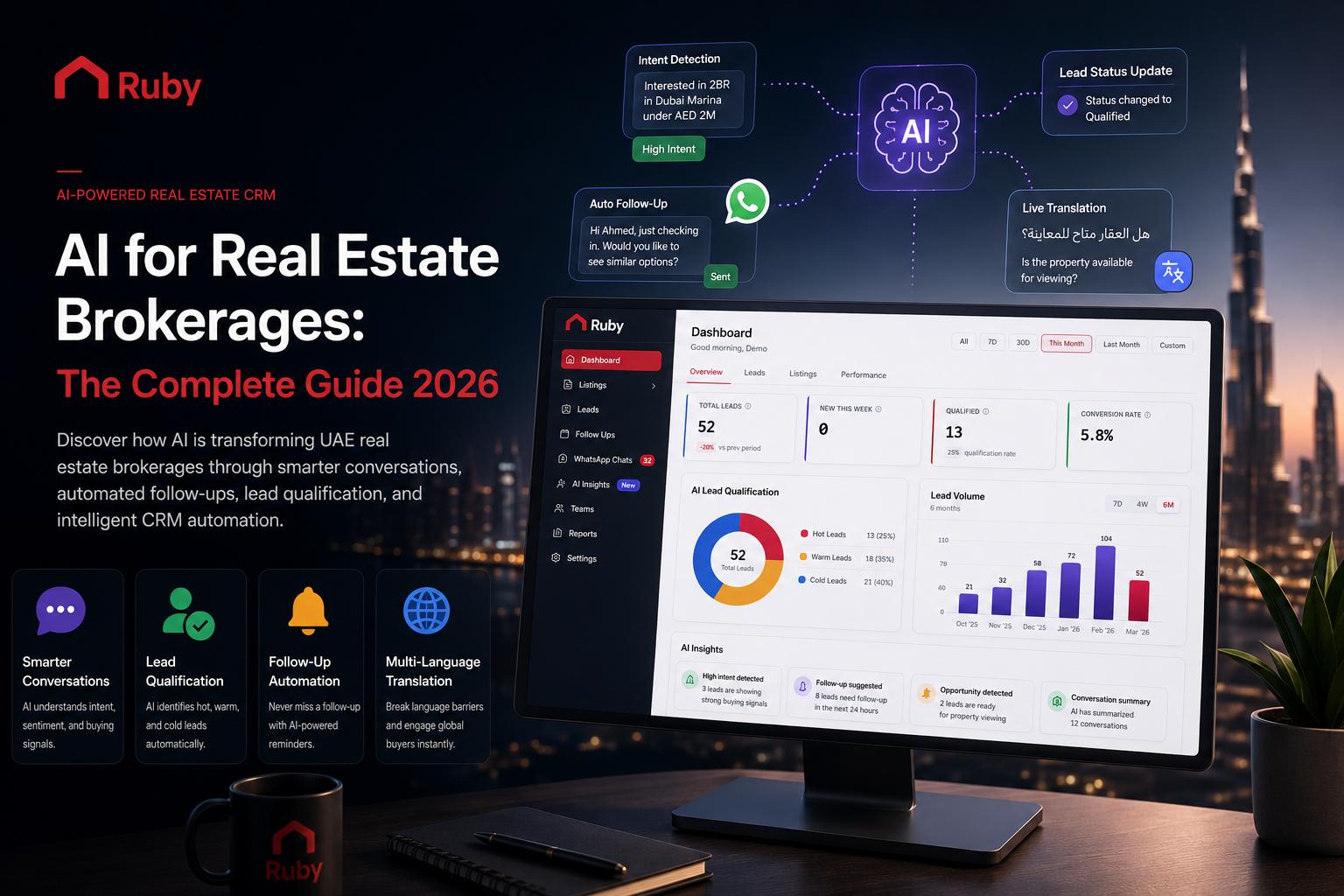
Rather than treating AI as a separate feature, Ruby CRM incorporates intelligence throughout the operational process.
Lead conversations can be analyzed automatically.
Follow-ups can be suggested based on conversation context.
Lead statuses can be updated intelligently.
WhatsApp interactions can be transformed into structured CRM records.
Language barriers can be reduced through translation capabilities.
The result is not simply more automation.
It is a brokerage environment where agents spend less time managing systems and more time building relationships.
The Future of the AI-Powered Brokerage
The next generation of brokerages will look fundamentally different from today's operations.
Agents will continue to play a central role.
Relationships will continue to matter.
Trust will continue to drive transactions.
What will change is the amount of operational burden carried by individuals.
AI will handle repetitive tasks.
Systems will surface insights automatically.
Conversations will become searchable intelligence.
Follow-ups will become systematic rather than accidental.
Brokerages will gain the ability to operate at a scale that would previously require significantly larger teams.
The competitive advantage will no longer come solely from generating leads.
It will come from how effectively those leads are managed after they arrive.
Conclusion
Artificial intelligence is not replacing real estate professionals.
It is enhancing their ability to operate effectively.
The brokerages that embrace AI successfully are not removing humans from the process. They are eliminating friction from the process.
By improving lead qualification, strengthening follow-up consistency, reducing manual administration, and transforming conversations into actionable insights, AI allows brokerages to focus on what they do best: serving clients and closing deals.
As the industry continues to evolve, the question is no longer whether AI will become part of brokerage operations.
The question is how quickly brokerages can adopt it and turn intelligence into a competitive advantage.