
The AI real estate CRM buyer's guide for Dubai brokerages (2026 edition)
Choosing the right CRM can transform your brokerage. Compare AI-powered and traditional real estate CRMs, evaluate key features, and find the best CRM for Dubai brokerages in 2026.
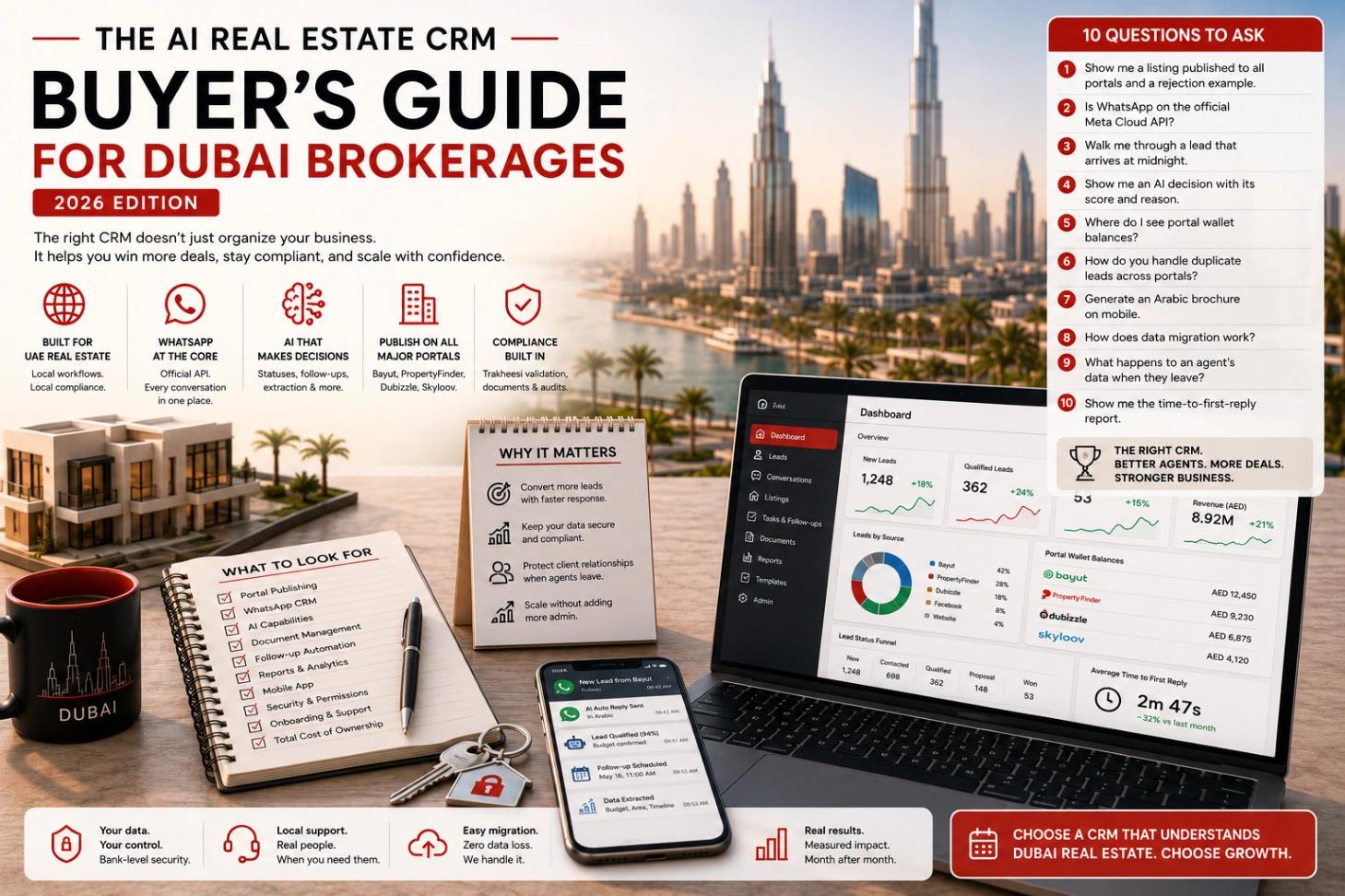
Choosing a CRM is one of those decisions a brokerage makes once every few years and then lives with every single day. Get it right and the whole operation runs on one system; get it wrong and you've paid for software the agents work around instead of with. This guide is for brokerage owners and sales directors in the UAE comparing platforms in 2026: what actually separates the options, which features matter versus which ones just demo well, what to ask vendors, and how to think about the cost.
Why a generic CRM struggles in Dubai
Salesforce, HubSpot, Zoho, and the other general-purpose platforms are good software. They're also built around a sales motion that doesn't look much like a Dubai brokerage. A generic CRM has no concept of a listing that needs to exist simultaneously on Bayut, PropertyFinder, Dubizzle, and Skyloov, each with its own field formats and approval states. It has no idea what a Trakheesi permit is, so it can't stop an agent from publishing an ad that RERA would flag. It treats WhatsApp, the channel carrying most client communication in this market, as a third-party bolt-on at best. And it assumes conversations happen in one language, in a city where a single agent's Tuesday might involve Arabic, Russian, and Hindi before lunch.
You can bend a generic CRM toward all of this with custom fields, middleware, and consultants. Some brokerages do. What they end up with is an expensive, fragile approximation of what a purpose-built platform does out of the box, and every portal API change becomes their problem to patch. The first real filter in any evaluation is simple: was this system built around UAE real estate workflows, or is real estate a template installed on top of something else?
The features that matter, and the ones that just demo well
Vendor demos are designed around whatever looks impressive in twenty minutes. The features that determine whether the platform works at month six are usually less flashy.
Portal publishing is the backbone. Look for one listing entry that publishes to all four major UAE portals, with per-portal status tracking, portal-specific error messages when something is rejected, permit validation before send, and wallet balances visible inside the CRM. If the "integration" turns out to be a data feed the vendor uploads on a schedule, or worse, an email parser, keep looking.
WhatsApp needs to live inside the CRM, not beside it. That means per-agent inboxes on the official Meta Cloud API, full conversation history attached to the lead record, approved templates that auto-send on new leads, and media, voice notes, and documents all in the thread. The official-API point matters more than it sounds: platforms using unofficial WhatsApp bridges get numbers banned, and a brokerage losing the number its clients have saved is a genuine business injury.
AI should mean judgment, not just automation. Syncing a listing or catching a webhook is automation; every serious platform has it. The question to ask is what decisions the system makes from unstructured conversation: does it update lead statuses from WhatsApp threads, schedule and move follow-ups based on what the client said, extract budget and preferred areas into structured fields, transcribe voice notes and portal call recordings? And critically: is every one of those decisions logged with its reasoning, reversible by an agent, and adjustable by an admin? AI without an audit trail is a black box you're being asked to trust with your pipeline.
The unglamorous layer decides long-term fit: role-based permissions, document generation (brochures, NOCs, lease agreements) straight from listing data in English and Arabic, secure document storage with expiring share links for title deeds and IDs, duplicate-lead detection across portals, and a proper mobile app rather than a shrunken website. None of this demos well. All of it is what agents touch daily.
Ten questions to ask in every vendor demo
- Show me one listing published to Bayut, PropertyFinder, Dubizzle, and Skyloov, and then show me what a rejection from one portal looks like.
- Is the WhatsApp integration on the official Meta Cloud API, and does each agent get their own connected number?
- When a client replies on WhatsApp in Russian at midnight, walk me through everything that happens before an agent wakes up.
- Show me a status change your AI made, the confidence score, and the logged reason. Now show me an agent overriding it.
- Where do I see my Bayut and PropertyFinder wallet balances without leaving the CRM?
- A client enquired on two portals under the same phone number. One lead or two?
- Generate an Arabic brochure for this listing, right now, on a phone.
- What exactly happens during data migration, and who does the work?
- What can a junior agent see and export? What happens to their leads when they resign?
- Show me the report that tells me each agent's average time-to-first-reply last month.
A vendor who handles all ten live is showing you a real platform. A vendor who says "that's on the roadmap" more than twice is showing you a pitch deck.
What AI should actually do (and not do)
The right mental model for AI in a CRM is a very fast assistant with no ego: it reads every conversation, keeps the records current, drafts and suggests, and flags what needs a human, while the human keeps final say. In practice that looks like status changes applied only above a confidence threshold, a daily digest summarizing every action the AI took, sentiment and intent tags on conversations so managers can spot a frustrated client before it becomes a lost one, and reply suggestions drawn from the brokerage's own closed deals.
What AI should not do is talk to clients autonomously in ways the brokerage can't review, make irreversible changes, or operate without an off switch. If a vendor can't show you where the admin turns the AI down or off, that's a design philosophy problem, not a missing feature.
Analytics that answer real questions
Dashboards are easy to build and easy to fill with vanity numbers. The test is whether the platform can answer the questions an owner actually asks: how long do leads sit before a human replies, broken down by agent and by source? Which listings are underperforming similar properties on impressions and clicks? What's the qualification rate per portal, so marketing spend follows evidence instead of habit? Which stage of the pipeline is leaking? A leaderboard is nice. A report that shows conversion is fine but reply time averages four hours is a business decision waiting to happen.
Implementation: what good looks like
The pattern behind most failed CRM projects isn't bad software; it's a six-month rollout that exhausts everyone before the value shows up. A realistic sequence for a UAE brokerage is: listings and contacts imported in the first days (usually from the spreadsheets being replaced), portal accounts and WhatsApp numbers connected in week one, a pilot group of agents running live in week two, and the full team on by weeks three to four, with the old tools kept read-only in parallel until nobody has opened them in a month. Adoption is the real deliverable. A platform agents actually use at 80% of its capability beats a more powerful one they quietly abandon, which is why training quality and support responsiveness belong in the evaluation alongside features. Ask existing customers how long the vendor took to answer their last support message; the answer is more informative than any SLA page.
Thinking about cost and return honestly
CRM pricing in this market is typically per agent per month, and the subscription is rarely the real number. The real comparison is total monthly cost against two savings lines: admin hours (portal re-entry, photo formatting, brochure assembly, report building, all quantifiable at your listing volume) and conversion (faster first response and reliable follow-ups reclaiming leads you already paid the portals for). A brokerage running 200 leads a month doesn't need much conversion improvement for the software to cost less than the leads it stops wasting. Run that arithmetic on your own numbers rather than trusting anyone's ROI calculator, including the vendor's, and be suspicious of any pitch built on savings it can't tie to a line in your own operation.
The short checklist
Before signing anything, you should be able to answer yes to each of these: built specifically for real estate, with UAE portals integrated natively. Official WhatsApp API, per agent, inside the CRM. AI that makes logged, reversible, adjustable decisions. Trakheesi-aware publishing. Document generation in English and Arabic. Role-based permissions and an audit trail. Mobile apps agents will actually use. Migration handled by the vendor, measured in days. Reporting that shows reply times and pipeline leaks, per agent. Reference customers in Dubai you're free to call.
Frequently asked questions
What is an AI real estate CRM?
A CRM that makes judgment calls from unstructured input instead of only storing what agents type: reading WhatsApp conversations to update lead statuses, extracting budgets and preferences into structured data, scheduling follow-ups from what was said, and transcribing calls and voice notes. The dividing line from a traditional CRM is whether the record stays current when nobody is doing data entry.
Why do Dubai brokerages need a specialized CRM instead of Salesforce or HubSpot?
Because the daily workflow is portal publishing, Trakheesi compliance, WhatsApp-first communication, and multilingual clients, none of which generic platforms handle natively. Adapting one with custom development is possible but usually costs more than a purpose-built platform and breaks whenever a portal changes its API.
How does AI actually improve lead conversion?
Mostly by removing delay and forgetting: instant personalized first responses hold the client's attention, automatic follow-up scheduling means no lead dies of neglect, extracted preferences let agents match old leads to new inventory, and translation removes the wait for a colleague who speaks the client's language. Each fix is small; stacked across every lead, they move the conversion rate in a way more ad spend can't.
Which property portals should a UAE CRM integrate with?
Bayut, PropertyFinder, and Dubizzle at minimum, with Skyloov increasingly expected, plus Meta Lead Ads for social campaigns and a feed for the brokerage's own website. Integration should mean two-way sync with live status, leads, and wallet visibility, not a one-way data dump.
How long does CRM implementation take for a brokerage?
For a purpose-built platform, live within days and fully adopted within about a month: data import in the first couple of days, portals and WhatsApp connected in week one, pilot agents in week two, everyone by week four. Anything quoted in quarters is a sign the platform wasn't built for this industry.
If you're evaluating platforms right now, the fastest way to pressure-test this whole guide is to bring the ten demo questions to a Ruby CRM walkthrough. It's 30 minutes on your own data, and question four, the AI audit trail, is the one we most enjoy answering.