
How top Dubai brokerages respond to every lead in the first five minutes
how top Dubai brokerages respond to every lead within five minutes using automation, WhatsApp, and smart lead routing to boost conversions and close more deals.
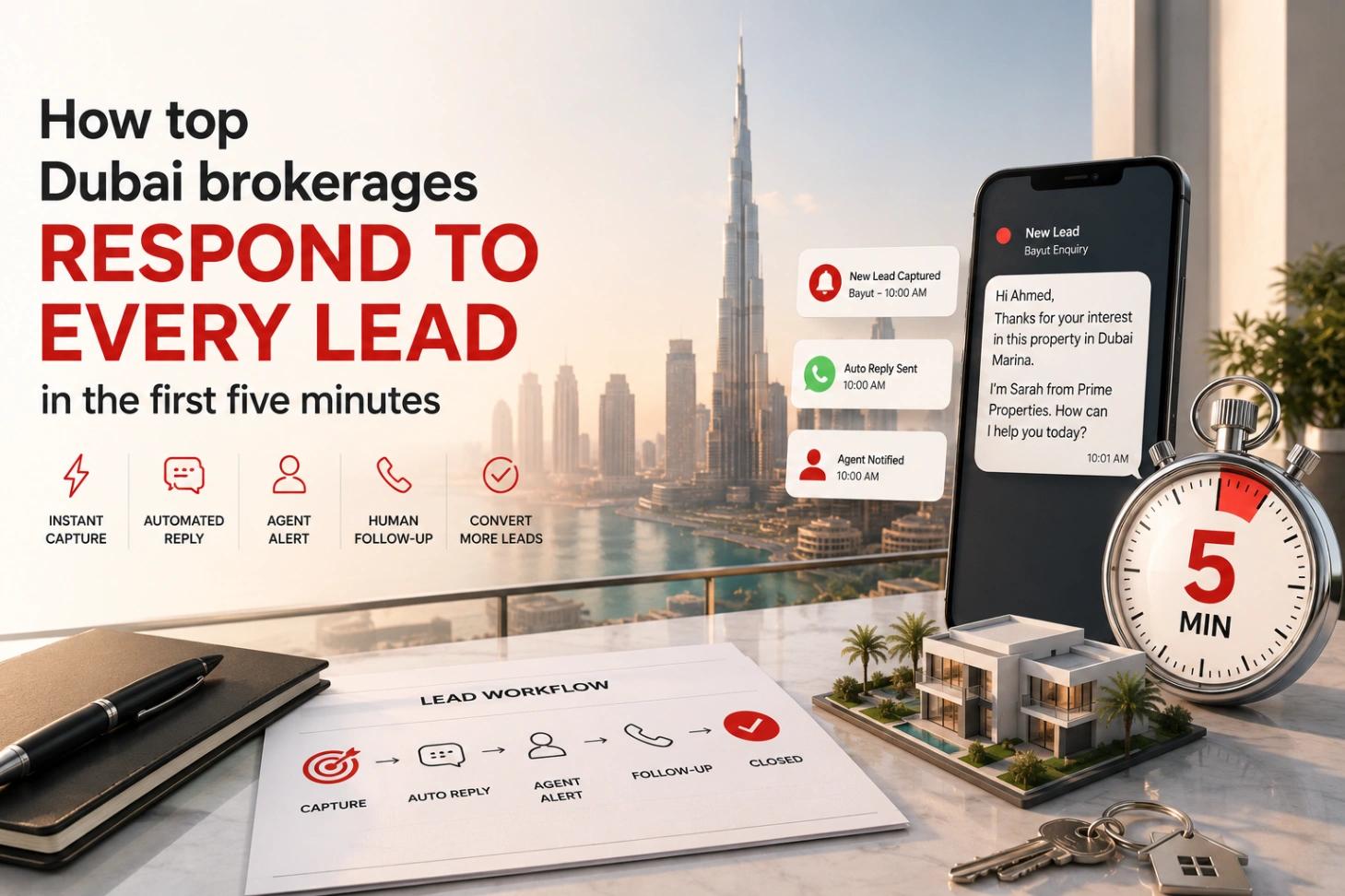
Five minutes isn't long enough for a client to forget why they submitted an enquiry, but it's plenty long enough for them to submit the same one to two other brokerages while they wait. In a market like Dubai, where the same buyer is often browsing the same unit type across Bayut, PropertyFinder, and Dubizzle at once, whichever brokerage actually talks to that client first tends to keep the conversation. Everyone after that is chasing.
The numbers behind this have been known for years. The best-known lead response study, run by James Oldroyd across millions of sales calls, found that the odds of reaching a lead who enquired five minutes ago are roughly 100 times better than reaching one who enquired half an hour ago, and the odds of qualifying them are about 21 times better. A Harvard Business Review audit of over 2,200 companies found the average firm took 42 hours to respond to an online lead, and nearly a quarter never responded at all. Those studies weren't about Dubai real estate, but Dubai real estate is a worse version of the same problem: more channels, more competitors on the same listing, and a buyer who is often awake when your office isn't.
The brokerages that consistently hit five minutes aren't relying on one lucky agent who happened to see a notification in time. The first five minutes of a lead's life follow a specific, repeatable sequence, part automatic and part human, and it's worth walking through exactly what happens at each stage, because the automation alone isn't the whole story.
Why five minutes is the honest benchmark
A lot of "instant response" marketing focuses on the automated first message, which can genuinely go out in seconds. That's real, and it matters, but it isn't the same thing as a client actually being spoken to. Five minutes is a fairer number because it covers the part that's harder to automate away: an agent seeing the lead, understanding what it's about, and making real contact, by phone or by a genuine reply, while the client is still paying attention. A brokerage that only measures the automated ping and stops there is grading its own homework.
The first few seconds: capture and routing
None of this starts with a person noticing anything. When a client submits an enquiry on Bayut, Bayut sends a webhook the instant it happens. Ruby verifies the signature, works out what kind of lead it is, a call, a WhatsApp enquiry, an email, a project inquiry, and creates the lead record matched to the right listing within moments. PropertyFinder and Facebook Lead Ads leads arrive the same way, through their own verified webhooks, with full lead data pulled from each platform's API before a human is involved at all. As a backup, Bayut leads are also caught by a periodic sync in case any single webhook is ever missed, so a lead can't quietly disappear because of one dropped request.
Routing happens just as fast. If the enquiry is about a specific listing, it goes straight to that listing's agent, since they know the property best. If there's no listing match but the lead came through an agent's own portal profile, it goes to that agent instead, matched by portal ID, then email, then phone number. Anything left over lands in a shared pool where any available agent can claim it, rather than sitting unassigned. By the time anything gets sent out, the system already knows exactly whose lead this is.
The next thirty seconds: a message that sends itself
This is the part that actually buys the brokerage time. An approved WhatsApp template goes out automatically, addressed to the client by name, referencing the actual property they enquired about, with the assigned agent's name attached, built from more than ninety possible fields pulled straight from the CRM data. A short set of checks runs first: the lead needs a valid phone number, no message can have gone out to them already, and the agent needs an active WhatsApp connection with auto-send switched on. If a required detail is missing, a listing with no price set, for instance, the send is skipped rather than going out broken. Once sent, the lead is flagged so the same message never goes out twice, even if it's reassigned to a different agent later.
The client now has a reply in hand before they've had time to message anyone else. But a template, however well personalized, isn't a conversation. That's where the next four minutes matter more than the first thirty seconds.
Minute one to two: the agent actually sees it
The moment a lead is created and assigned, the agent gets notified, in-app, by email, or by WhatsApp depending on their own preferences, and it arrives instantly over the same real-time connection that pushes new WhatsApp messages into their chat view without a page refresh. There's no dashboard to refresh and no separate inbox to check. The lead shows up already carrying context: which portal it came from, what property it's tied to, and, if this same client has reached out before through a different channel, a flag showing that history rather than treating them as a stranger.
This is also where a returning client gets recognized. If the same phone number inquired on Bayut two months ago and again on PropertyFinder today, the agent sees that immediately, rather than opening with an introduction the client has already heard once.
Minute two to five: the human follow-up that actually converts
This is the part no automation replaces, and it's also the part that separates brokerages that talk about speed-to-lead from ones that deliver it. With the context already in front of them, the agent calls the client directly, or sends a genuine, specific WhatsApp reply that goes beyond the automated template, while the enquiry is still fresh. If the client replies to the automated message before the agent gets there, the system is already listening: incoming messages are analyzed for intent and sentiment on a short debounce window of about two minutes, so a reply that signals real interest, a specific question, or growing frustration gets flagged for the agent almost as fast as the message itself arrives.
Language stops being a delay here too. If the client wrote in Arabic, Russian, or Mandarin, the agent is reading a live translation and replying in English, with the client receiving it back in their own language. In the old workflow, "wait for the colleague who speaks Russian to get off their call" could eat the entire five-minute window on its own.
By the five-minute mark, in a brokerage built for this, the client is past the automated acknowledgment and into a real conversation with a person who already knows what they're asking about.
The midnight lead
A large share of Dubai enquiries arrive when the office is closed: a London investor browsing after work, a Singapore buyer during their lunch break, a resident scrolling portals at 11 p.m. The five-minute rule doesn't suspend itself at night, but the sequence changes shape. The automated message still goes out within seconds, in the client's language, which holds their attention in a way silence never does. If they reply, the AI reads the conversation overnight: budget, preferred areas, and timeline get extracted and stored, intent gets scored, and a follow-up is waiting on the agent's calendar for the morning. The agent walks in at 9 a.m. to a lead that has already introduced itself, instead of a cold notification from ten hours ago. It's not as good as a live human at midnight, but it's a long way from losing the lead entirely, and it costs the brokerage nothing per night.
What it looks like without this sequence
Take away any one part of this chain and the five-minute window quietly disappears. Without instant webhook capture, a lead sits in a portal inbox until someone happens to check it. Without automatic routing, it waits for a manager to notice and assign it. Without the auto-message, the client hears nothing at all until an agent gets free, sometimes hours later, by which point they've likely already spoken to someone else. And without real-time notification, even a fast auto-message doesn't help, since the agent still doesn't know to pick up the phone. Each missing piece adds delay, and delay is the one thing a lead this fresh can't absorb without losing interest.
Measuring the whole five minutes, not just the first second
Because every automated message is tagged with what triggered it, and every WhatsApp thread shows exactly when the client's message came in versus when the agent actually replied, a brokerage can see the real gap between "a message went out" and "a person responded," broken down by agent and by lead source. That's a very different, and much more honest, metric than confirming the auto-reply fired on time. It's the number that actually predicts whether a lead converts, and it's the one most brokerages have never been able to see clearly until they started tracking it.
Getting the automated first thirty seconds right is table stakes at this point. What separates the brokerages that win these leads is what happens in the four minutes after that: whether a real person, armed with the right context, gets to the client before anyone else does.
Frequently asked questions
What is a good lead response time for real estate?
Under five minutes for genuine human contact, not just an automated acknowledgment. Response odds fall off steeply after that: the Oldroyd research put the drop between five and thirty minutes at roughly 100x for making contact at all. Most brokerages that measure themselves honestly for the first time find their real average is measured in hours.
Do automated WhatsApp replies annoy clients?
A generic blast does. A message that arrives within seconds, uses the client's name, names the exact property they asked about, and comes from the specific agent who will call them reads as responsiveness, not spam. The difference is personalization pulled from real data, and following it quickly with a human.
How should a brokerage handle leads that arrive overnight?
Automate the first touch, capture everything the client says, and have the human follow-up scheduled before the agent wakes up. The goal at midnight isn't to close; it's to be the first brokerage the client has a real exchange with, so the 9 a.m. call is a continuation instead of a cold start.
How do you actually measure lead response time?
Track two timestamps per lead: when the enquiry was created, and when a human first replied or called, and report the gap by agent and by source. If your system can only show you when the auto-reply went out, you're measuring your software, not your team.
If you want to know your team's real number, book a Ruby CRM walkthrough. It runs on your own lead flow, and the first thing it usually shows a brokerage is the gap they didn't know they had.