
The hidden cost of manual follow-ups
Missed follow-ups silently reduce conversions and cost brokerages valuable deals. Learn how automated follow-up tracking with Ruby CRM keeps every lead on track
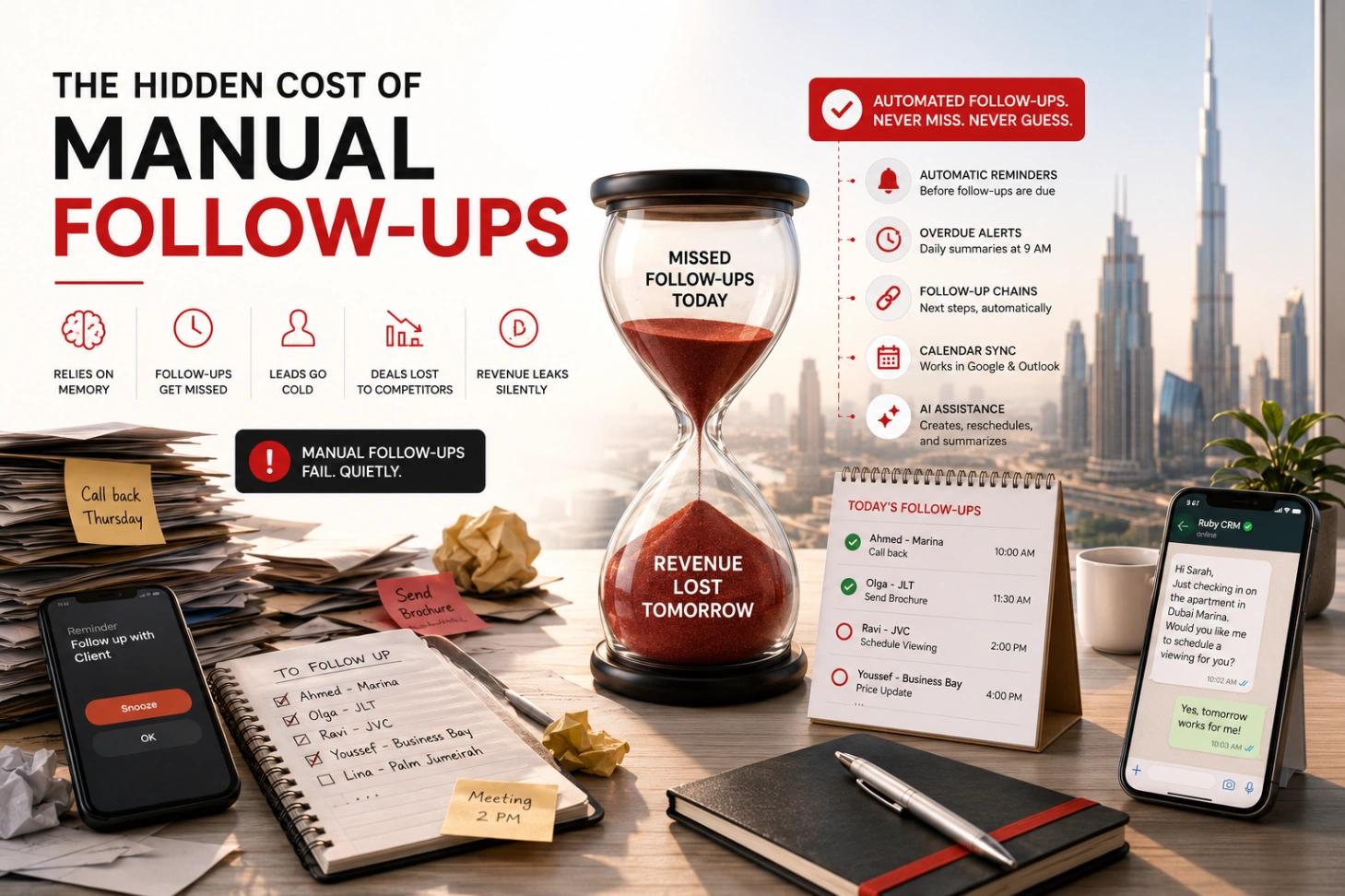
No brokerage in Dubai has a line item on its budget for "missed follow-ups." That's exactly why the cost never gets addressed. It never appears as an expense, only as a slightly lower conversion rate, a client who went quiet, a deal that somehow went to a competitor who called back first. Nobody writes that down as a cost, so nobody fixes it.
Manual follow-up tracking feels free because it doesn't require buying anything. An agent jots a note, sets a mental reminder, maybe adds a task to their phone's calendar. No software, no subscription, no line item. But free to set up isn't the same as free to run, and a follow-up system built on memory has a failure rate that compounds every week it runs.
The math of memory at volume
Here's the uncomfortable arithmetic. A twenty-agent brokerage handling 300 active leads, with an average of three follow-up commitments per lead over its lifecycle, is carrying roughly 900 time-sensitive promises at any given time. Suppose the agents are genuinely excellent and each individual follow-up has a 95% chance of happening on schedule. At 900 commitments, that still means about 45 follow-ups slipping every cycle, and 95% reliability is generous for a human juggling viewings, portal updates, and forty leads at once.
If even a tenth of those slipped follow-ups were leads that would have converted, that's four or five deals a month lost to nothing. No competitor outbid them, no client changed their mind, no market shift. The lead just outlasted the memory of the person holding it. This is the number worth sitting with, because it's the one that never appears in any report.
The follow-up that only exists in someone's head
A follow-up written on a sticky note, or remembered as "I'll call her back Thursday," is competing with everything else on an agent's plate: three viewings, a portal listing that needs updating, a client asking about a title deed, and forty other leads at various stages. Thursday arrives, something more urgent comes up, and the follow-up slides to Friday, then to "next week," then off the list entirely. Nobody decided to drop the lead. It just lost every single time it competed against something more immediately visible.
This is the part that's easy to miss: a manual follow-up doesn't fail because an agent is careless. It fails because human memory is a bad place to store time-sensitive commitments when there are dozens of them running at once. The failure is structural, not personal, which is exactly why hiring more disciplined agents doesn't solve it. Neither does another motivational team meeting about "staying on top of leads." The team already wants to stay on top of leads. The storage medium is the problem.
What "overdue" actually costs
A missed follow-up rarely announces itself. The client doesn't send an email saying they gave up waiting. They just go quiet, or they call the next brokerage on their list, and the agent finds out weeks later, if at all, that the lead is gone. The brokerage already paid for that lead once, whether through a portal subscription, an ad campaign, or an agent's time on the phone. A missed follow-up means paying for a second lead to replace value that already existed and was lost to neglect rather than to a real "no."
That cost is invisible in a way marketing spend isn't. A brokerage can see exactly what a Bayut package or a Facebook campaign costs down to the dirham. Almost none can say what a missed follow-up costs, because nobody is tracking how often it happens, let alone what each instance was worth.
Where manual tracking breaks
A few patterns repeat across brokerages that still run follow-ups by memory and sticky note:
- A follow-up gets written down, but never resurfaces at the right time, so it's remembered a day late or not at all.
- An agent goes on leave, and their pending follow-ups go with them, since nobody else knows they exist.
- A manager has no way to see how many follow-ups are overdue across the team without asking each agent individually, which nobody actually does.
- The same client gets a follow-up call from two different agents in the same week, because neither could see what the other had already scheduled.
- A follow-up gets done, but three days later than planned, by which point the client's urgency, and often their interest, has cooled.
None of these are dramatic on their own. Added up across a team of twenty agents handling a few hundred leads, they're the difference between a healthy pipeline and one that's bleeding out of sight.
What automatic follow-up tracking actually looks like
The fix has nothing to do with asking agents to be more organized. It's moving the follow-up out of memory and into a system that tracks time on its own. Ruby CRM does this by checking every hour for any follow-up whose scheduled time has passed and marking it overdue automatically, so nothing depends on an agent noticing the clock. About an hour before a follow-up is due, the assigned agent gets a notification. If a follow-up passes its time unhandled, it doesn't just sit there: at nine each morning, every agent gets a summary of what's overdue, so the day starts with a clear list rather than a guess.
Follow-ups can also be chained, so a call that leads to sending a brochure automatically queues the next step, schedule a viewing, rather than depending on the agent to remember the full sequence. And because each follow-up syncs to the agent's own Google or Outlook calendar, with the time zone set correctly for Dubai and the event colored by priority, it shows up somewhere the agent is already looking, not in a separate tool they have to remember to open.
Ruby's AI adds a layer most manual systems can't match at all: after analyzing a WhatsApp conversation, it can create a follow-up on its own, reschedule one that no longer makes sense, or cancel one if the client has clearly lost interest, all clearly marked as AI-generated so agents know what was scheduled by a person and what wasn't. A daily digest at nine each evening summarizes what the AI did that day, so nothing happens invisibly.
One lead, followed up properly
What this looks like on a single client: a buyer views a two-bedroom in JLT on Sunday and says she wants to think it over and discuss with her husband. The agent logs the outcome; a follow-up call is already chained for Wednesday. Tuesday night, the buyer messages on WhatsApp asking whether the price is negotiable. The AI reads the message, tags the intent as an early offer signal, and moves the Wednesday call up to first thing in the morning, flagged high priority on the agent's calendar. The call happens while the question is still warm, the brochure with comparable sold prices goes out in the same thread, and the viewing for the husband is booked before lunch.
Run the same lead through a sticky-note system: the Wednesday call happens Wednesday, if it happens, and the Tuesday-night message sits unread until someone opens the chat. Same agent, same buyer, same unit. The difference is that in the first version, nothing depended on anyone remembering anything.
The manager's blind spot
Ask a sales manager how many follow-ups are currently overdue across their team, and in most brokerages the honest answer is "I don't know." Finding out means asking each agent individually, and agents facing that question tend to round in their own favor. A manager running a team this way is flying without an instrument panel: they can see the conversion numbers at the end of the month, but not the specific behavior that produced them.
When every follow-up action is logged automatically, who scheduled it, when it was due, whether it was completed on time or slipped, that blind spot closes. A manager can see which agents consistently complete follow-ups on schedule and which ones are chronically late, as a specific, coachable fact rather than an accusation. That's a very different conversation than a vague sense that "the team could be more on top of things," and it works in the other direction too: the agent whose follow-up discipline is quietly carrying the team's numbers finally shows up in the data.
Turning follow-ups into a system instead of a memory test
The brokerages that convert well tend to share one trait: nothing about lead follow-up depends on a single person remembering to do it at the right time. The system remembers instead, flags what's due, escalates what's overdue, and gives a manager visibility without having to ask. Agents still make the calls, build the relationships, and close the deals. What changes is that the follow-up itself is no longer a test of memory under pressure.
That shift doesn't show up as a new expense on a budget. It shows up as leads that stop disappearing, clients who hear back when they expect to, and a pipeline that converts a larger share of what a brokerage already paid to bring in.
Frequently asked questions
How many follow-ups does a real estate lead actually need?
It varies by lead type, but most serious buyers need several touches across weeks: the initial response, a post-viewing check-in, answers to financing or negotiation questions, and timing nudges as their situation firms up. The pattern that kills conversion is stopping after the first unanswered call, which manual systems make almost inevitable because nothing resurfaces the lead.
What's the most reliable way to track follow-ups?
Any system where the follow-up exists as a timed record outside a person's head, with automatic overdue flagging and visibility for managers. A shared calendar is better than memory; a CRM that schedules, escalates, and logs follow-ups automatically is better than a calendar, because it also captures the ones nobody thought to create, like a reply that came in overnight.
How do I find out if my team is missing follow-ups?
Ask three questions: how many follow-ups are overdue right now, who owns each one, and how many were completed late last month. If the answers require polling agents one by one, follow-ups are being missed and there's currently no way to see how many. The absence of the number is the answer.
Can AI schedule follow-ups on its own?
Yes, when it can read the conversation. An AI layer that analyzes WhatsApp threads can create a follow-up when a client asks to talk next week, push one back when they mention travelling, or cancel one when interest is clearly gone, with every action labeled and logged so agents always know what was scheduled by whom.
If you want the actual number of follow-ups slipping through your team right now, book a Ruby CRM walkthrough. Overdue follow-ups are one of the first things the dashboard surfaces, and for most brokerages it's the first time anyone has seen the figure.
Ready to Transform Your Real Estate Business?
Join hundreds of brokers using Ruby CRM to automate lead management and close more deals.